
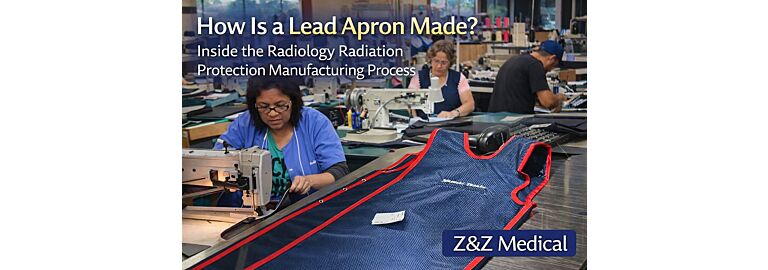
How Lead Aprons Are Made | Radiation Protection Manufacturing Guide
How Is a Lead Apron Made?
Understanding the Materials, Construction, and Science Behind Radiation Protection
Lead aprons are a critical part of radiation protection in healthcare, designed to shield clinicians and patients from scatter radiation during imaging procedures such as fluoroscopy, X-ray, and C-arm–guided interventions. While they may appear simple, radiation protection garments are engineered through a carefully controlled manufacturing process that ensures consistent attenuation performance, durability, and wearer comfort.
What Materials Are Used in Lead Aprons?
The protective core of a radiation protection apron is made from lead or lead-equivalent attenuation materials. Traditional aprons use flexible sheets of lead, while modern composite or lead-free designs incorporate combinations of high-density metals such as:
-
Bismuth
-
Tungsten
-
Antimony
-
Tin
-
Barium
These materials are selected because their high atomic numbers and density allow them to absorb or deflect X-ray photons, reducing radiation exposure to critical organs. The protective layer is typically encased in durable vinyl, polyurethane, or nylon outer coverings that provide flexibility, resistance to wear, and ease of cleaning.
Key Steps in the Lead Apron Manufacturing Process
1. Material Selection and Testing
Manufacturers begin by selecting shielding materials that meet regulatory standards for radiation attenuation. Each material batch is tested to ensure it meets required lead equivalence performance levels, commonly ranging from 0.25 mm to 0.5 mm lead equivalence.
2. Layering and Panel Construction
Shielding sheets are cut into panels based on the garment design. Multiple layers may be combined to achieve the required thickness while maintaining flexibility. Overlapping panels are often used to eliminate gaps and ensure continuous protection across the torso and shoulders.
3. Encapsulation and Outer Covering
The shielding core is sealed within protective outer fabrics that prevent cracking, contamination, and moisture intrusion. High-quality stitching and reinforced seams are critical to maintaining the garment’s long-term integrity.
4. Ergonomic Shaping and Assembly
Garments are shaped and assembled to provide anatomical coverage while distributing weight evenly across the shoulders and hips. Adjustable straps, closures, and belt systems are added to improve fit and reduce fatigue during extended procedures.
5. Quality Assurance and Attenuation Testing
Finished garments undergo inspection and attenuation testing to verify that they meet industry safety standards. Proper labeling indicates the apron’s lead equivalence rating, size, and manufacturing specifications.
How Thick Should a Lead Apron Be?
Radiation protection aprons are manufactured in various thickness levels depending on the intended clinical use:
-
0.25 mm Pb equivalence:
-
0.35 mm Pb equivalence:
-
0.5 mm Pb equivalence: (Most common)
Peer-reviewed studies have shown that properly fitted 0.5 mm lead-equivalent aprons can attenuate up to 98–99% of scatter radiation, helping protect radiation-sensitive organs such as the thyroid, breasts, lungs, and reproductive organs.
Are Lead Aprons Radioactive?
Lead aprons themselves are not radioactive. They do not emit or store radiation; instead, they act as passive barriers that absorb or deflect radiation from external sources. Once the imaging procedure ends, the apron does not retain radiation.
Why Quality Construction Matters
Because radiation protection depends on continuous shielding coverage, the way a garment is manufactured directly affects its performance. Proper material layering, seam construction, and ergonomic design ensure:
-
Consistent attenuation performance
-
Long garment lifespan
-
Reduced user fatigue
-
Reliable protection across critical organ areas
Routine inspection and proper storage are essential to maintaining that protection over time.
Supporting Safe Imaging Environments
Understanding how radiation protection garments are manufactured helps healthcare teams make informed decisions when selecting protective apparel. Choosing garments built with tested materials, ergonomic construction, and verified attenuation ratings helps ensure clinicians remain protected while performing the imaging procedures that support patient care every day.
For questions about radiation protection apparel, materials, or selecting the right garments for your department, contact info@zzmedical.com or call 800-410-9575 to speak with our team