
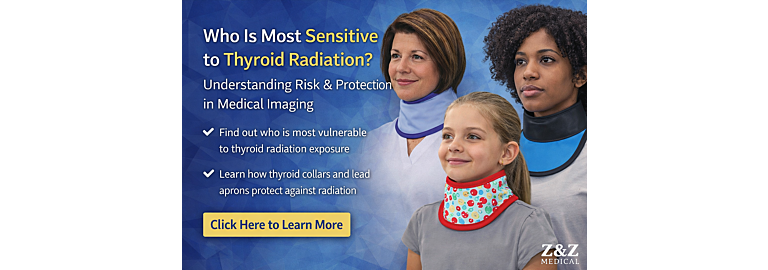
Who Is Most Sensitive to Thyroid Radiation? Understanding Risk & Protection in Medical Imaging
Who Is Most Sensitive to Thyroid Radiation — and How Do You Protect It?
The thyroid gland is one of the most radiation-sensitive organs in the human body. For healthcare professionals who work around X-ray, C-arm, and fluoroscopy equipment — and for patients who undergo imaging — understanding thyroid risk and protection is essential for long-term safety. Radiation exposure is unavoidable in modern medical imaging, but not everyone is affected the same way. Some people are far more vulnerable than others. Knowing who is most at risk — and how to protect them — helps facilities build safer radiation programs and protect their teams.
Why the Thyroid Is So Sensitive to Radiation
The thyroid is a small gland in the neck that regulates metabolism, growth, and hormone production. Its cells are particularly sensitive to ionizing radiation, which can damage DNA and trigger long-term health effects such as thyroid disease or cancer. Because of its location in the neck — close to many radiation beams used in imaging — the thyroid is especially vulnerable to scatter radiation during procedures like fluoroscopy, interventional radiology, and surgery guided by C-arm systems.
Who Is Most Sensitive to Thyroid Radiation?
Certain groups face significantly higher risk when exposed to radiation.
Children and Young Adults
The younger a person is, the more sensitive their thyroid tissue is. Growing cells divide rapidly, making them more vulnerable to radiation-induced damage. Exposure early in life can increase thyroid disease risk for decades.
Medical Professionals with Occupational Exposure
Radiologists, technologists, surgeons, and interventional specialists may be exposed to low-dose radiation daily for years. Long-term occupational exposure significantly increases the risk of thyroid dysfunction, autoimmune disease, and cancer.
People with Genetic or Thyroid Conditions
Individuals with a family history of thyroid disease or autoimmune disorders are more susceptible to radiation triggering thyroid problems. Even routine imaging can have a greater effect on predisposed individuals.
Women
Some studies suggest women may be more sensitive to radiation than men, particularly for thyroid-related effects. While research continues, it reinforces the importance of proper shielding.
Why Occupational Exposure Is a Major Risk
Procedures such as fluoroscopy, C-arm-guided surgery, and interventional cardiology create high levels of scatter radiation. Clinicians often work close to the radiation source for extended periods, placing the thyroid directly in the exposure zone.
Thyroid exposure increases with:
-
Time spent near the beam
-
Proximity to the patient
-
Frequency of procedures
Without shielding, radiation accumulates over years and creates measurable long-term risk.
How Radiation Exposure Is Reduced
Radiation safety follows three core principles:
Time – Minimize how long you are exposed
Distance – Stay as far from the source as possible
Shielding – Use protective equipment to block scatter radiation
For the thyroid, shielding is the most effective and practical protection.
How Effective Are Thyroid Shields?
A properly fitted thyroid collar dramatically reduces radiation reaching the neck. Research consistently shows thyroid shields reduce radiation dose by several times compared to no protection. In high-dose environments such as fluoroscopy, thicker thyroid shields (around 0.5 mm lead-equivalent) provide optimal protection. Lighter shields may be sufficient for lower-dose imaging such as routine X-rays, but shielding is still recommended because small doses add up over time. Fit matters just as much as thickness. A snug collar that wraps fully around the neck provides far better protection than one worn loosely.
How Thick Should Thyroid and Lead Protection Be?
For most clinical environments:
-
Thyroid collars: 0.25–0.5 mm lead-equivalent for X-ray, and 0.5 mm for fluoroscopy and interventional procedures
-
Lead aprons: 0.5 mm lead-equivalent provides up to 99% attenuation of scatter radiation
Facilities should always consult their radiation safety officer to ensure proper protection levels for each procedure and verify state regulations regarding protection as state laws vary.
Why Protective Garments Must Be Maintained
Even the best protective equipment fails if it isn’t cared for properly. Over time, lead garments can develop:
-
Cracks
-
Holes
-
Creases in the shielding layer
These defects can grow quickly and significantly reduce protection. Protective garments also collect bacteria, fungi, and viruses through daily use. Studies have found contamination on the majority of uncleaned lead aprons and thyroid shields — including organisms that cause serious infections.
That’s why facilities should:
-
Inspect lead garments annually
-
Store them properly on racks
-
Clean and disinfect them regularly
-
Replace damaged or worn equipment
Why Thyroid Protection Matters
Even low-dose imaging contributes to cumulative radiation exposure. A single chest X-ray delivers a small amount of radiation — but when multiplied across years of daily imaging, that dose becomes significant.
Radiation exposure is linked to:
-
Thyroid cancer
-
Hyperthyroidism
-
Thyroid nodules and disease
Protecting What Matters Most
The thyroid is one of the most vulnerable organs in medical imaging environments — but it is also one of the easiest to protect. By using properly fitted thyroid collars, maintaining protective garments, and following radiation safety best practices, facilities can protect their teams today while preventing serious health risks in the future.
At Z&Z Medical, radiation protection isn’t optional — it’s a commitment to long-term safety, compliance, and confidence. Have a question? Email us at info@zzmedical.com